Comparison Guide
AI Automation vs Virtual Receptionist
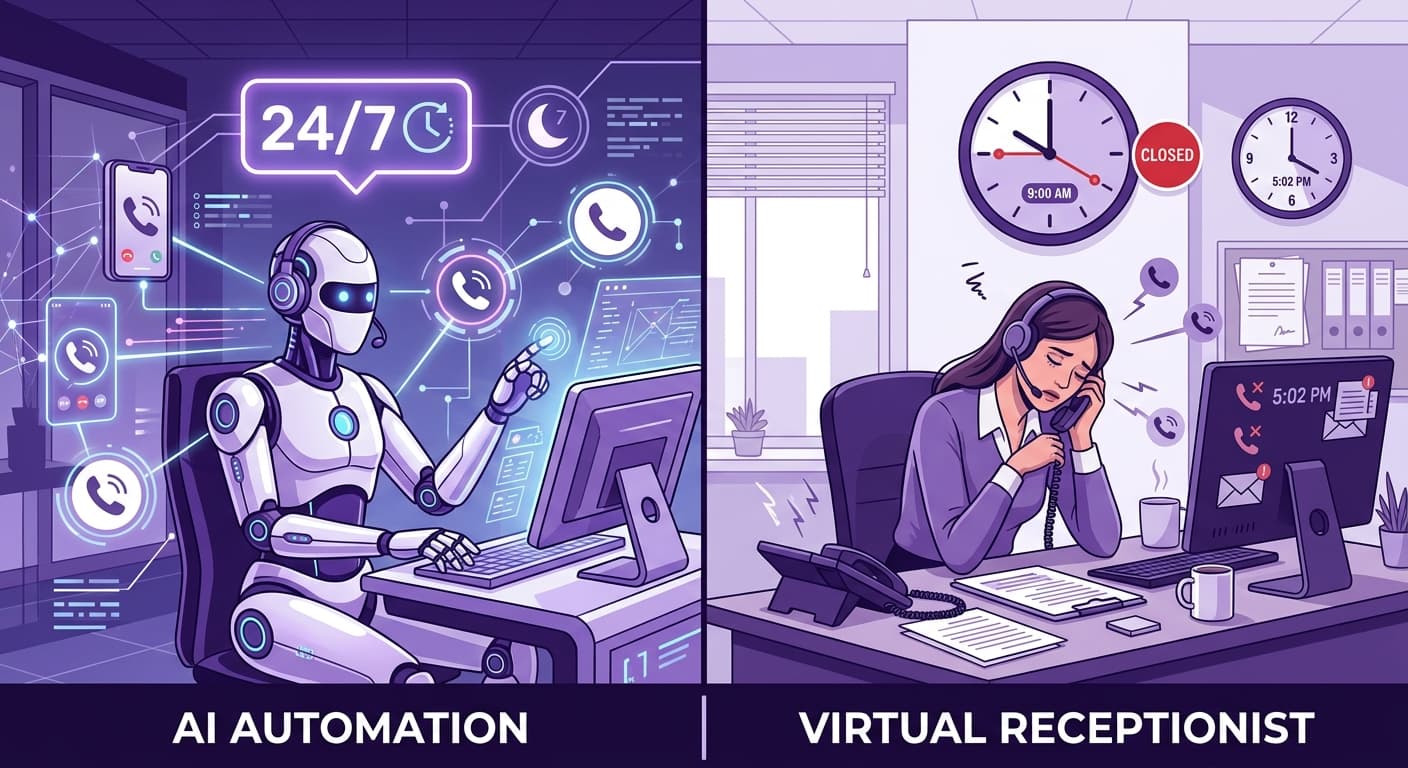
You miss a call. The caller moves on. Both AI automation and virtual receptionists try to fix this problem, but one costs a fraction of the other and never takes a break.
The Front-Desk Problem Every Service Business Faces
Whether you run an HVAC company, a dental clinic, or a legal practice, the story is the same: your phone rings while your team is with a client. The caller hangs up. They call a competitor. You just lost a job worth hundreds — or thousands — of dollars.
For years the standard fix was a virtual receptionist service. A real person, working remotely, answers your phone when you cannot. It works — during business hours, at least. But the per-minute billing adds up fast, the service quality varies from operator to operator, and scaling means paying even more.
Now there is another option. AI can answer calls, qualify leads, book appointments, and follow up without anyone in the loop. Here is how the two compare so you can decide what makes sense for your business.
Side-by-Side Comparison
When a Virtual Receptionist Makes Sense
Virtual receptionists are not dead. There are real situations where a human on the phone is the better call:
- Complex conversations requiring empathy. If callers are in emotionally charged situations (personal injury, grief counseling, sensitive medical referrals), a human voice carries nuance that AI cannot match yet.
- Highly variable intake processes. When every caller has a unique, unpredictable set of needs and the intake script changes constantly, a flexible human may handle edge cases better.
- Very low call volume. If you receive fewer than five calls a week, the math may not justify any outsourced solution. You might just answer the phone yourself.
Bottom line: virtual receptionists work best when every call needs real human judgment and your volume is low enough that the per-minute billing does not sting.
When AI Automation Wins
For most service businesses, AI wins. Here is why:
- After-hours coverage without overtime. Most missed calls happen after 5pm. AI answers at 2 AM the same way it answers at 2 PM. No overtime.
- High-volume call handling. During peak seasons, an HVAC company might receive 50+ calls per day. AI handles them all simultaneously. A virtual receptionist service would need multiple operators, multiplying your bill.
- Consistent lead qualification. AI asks the same qualifying questions every time, scores the lead, and routes hot prospects to your sales team within seconds. No training drift. No bad days.
- Automated follow-up. After the call, AI sends a confirmation text, adds the contact to your CRM, and kicks off a follow-up sequence. A human receptionist would still be typing notes.
- Flat-rate pricing. At $500 per month, you know your cost regardless of call volume. No surprises when your busiest month arrives.
The Best of Both Worlds
Some businesses use both. AI handles the routine stuff: basic questions, lead qualification, booking, follow-up texts. A human steps in when the conversation needs empathy or complex judgment.
You catch every lead, even at 3 AM on a Saturday, without paying $3/min for a human to answer "What are your hours?" AI triages. Humans close. Cost per lead drops. Close rate stays the same.
BondStack builds this for HVAC contractors, dental clinics, law firms, and other service businesses across Canada and the US. Call answering, lead qualification, booking, follow-up. Live in 7 days, with plans starting at $99 CAD.
Find Out Which Automations Fit Your Business
Answer 5 quick questions and get a personalized automation report — free, no commitment.
Keep Reading
- Our AI Automation Services — plans, pricing, and what you get
- BondStack Blog — guides on AI automation for service businesses
- AI Automation vs Hiring an Admin — compare AI with adding headcount